10 Tips for Ultralight Backpacking: Cut Pack Weight Without Cutting Safety
Going ultralight isn't about spending more money — it's about being ruthless with what you carry. These 10 principles help you find and eliminate what's weighing you down.
Key Takeaways
- 1. Start With the Big Three: The biggest weight savings come from the three heaviest items in most backpacks: your shelter, sleep system, and backpack itself.
- 2. Weigh Everything — Then Build a Gear Spreadsheet: You cannot make intelligent packing decisions without data.
- 3. Choose Multi-Purpose Gear: Every item that serves only one purpose is a weight liability.
- 4. Attack Your Clothing System: Overpacking clothes is one of the most universal beginner mistakes.
Going ultralight isn't about spending more money. It's about being ruthless with what you carry — asking hard questions about every item, cutting duplicates, and choosing gear that earns its weight by doing more than one job.
Most backpackers discover ultralight principles the same way: after one too many trips where sore shoulders and aching knees made the second day miserable. A heavy pack doesn't just slow you down — it compounds fatigue over miles, increases injury risk, and drains the enjoyment out of an experience you're supposed to be loving.
The good news: most beginners are carrying 5-10 pounds of unnecessary weight. You don't need to replace all your gear to feel the difference. These 10 principles will help you find and eliminate what's weighing you down, starting today.
1. Start With the Big Three
The biggest weight savings come from the three heaviest items in most backpacks: your shelter, sleep system, and backpack itself. These are collectively called the Big Three, and focusing on them first gives you the best return on any investment — or effort.
Traditional tents can weigh 5-6 pounds. Modern ultralight shelters weigh 1-2 pounds. A conventional sleeping bag might weigh 3-4 pounds; a high-quality down quilt or sleeping bag rated for your actual conditions might weigh under 1.5 pounds. A standard backpacking pack can weigh 5-6 pounds empty; ultralight options come in at 1-2.5 pounds.
Getting your Big Three under 8-10 pounds combined is a transformative change that outweighs every other optimization on this list. Start there before sweating the small stuff.
2. Weigh Everything — Then Build a Gear Spreadsheet
You cannot make intelligent packing decisions without data. The phrase most experienced ultralight hikers live by: pay attention to the ounces, and the pounds take care of themselves.
Get a small digital kitchen scale and weigh every item you plan to bring. Build a spreadsheet — a free template from LighterPack.com works well — and list every item with its actual weight. The total will surprise you. Often a few heavy items account for a huge proportion of total weight, while dozens of small items add up quietly in the background.
After each trip, note what you didn't use. Items that come home untouched on multiple trips are candidates for removal. The goal isn't minimal survival gear — it's the minimum necessary for a safe, comfortable trip.
3. Choose Multi-Purpose Gear
Every item that serves only one purpose is a weight liability. Every item that serves two or more purposes is pulling its weight and then some.
Classic examples: trekking poles that double as tent poles for a tarp or ultralight shelter. A rain jacket that serves as both shell layer and wind layer. A titanium mug that functions as pot, bowl, and cup. A buff that works as sun protection, wind barrier, camp towel, and face covering. A sleeping pad that doubles as a pack frame insert for a frameless ultralight pack.
Before buying any new piece of gear, ask: what else can this do? And before packing any item, ask: is there something I'm already bringing that could do this job instead?
4. Attack Your Clothing System
Overpacking clothes is one of the most universal beginner mistakes. Most people bring far more clothing than they need, much of it just-in-case items that never come out of the pack.
The efficient approach: think in two categories — hiking clothes (what you move in, which will get sweaty) and camp clothes (what you sleep and rest in, which stay dry). You need one set of each, not multiples. A merino wool t-shirt, a single insulating mid layer, and a rain jacket cover an enormous range of conditions.
Leave anything made of cotton at home. It absorbs sweat, holds moisture against your skin, and provides no insulation when wet. The three-layer system gives you a complete framework for selecting exactly what you need — and nothing more.
5. Rethink Your Sleep System
The sleeping bag is one of the most weight-dense items in a traditional backpacking kit, and it's also an area where meaningful weight savings are achievable without sacrificing warmth.
Down insulation offers the best warmth-to-weight ratio available. A quality 20°F down sleeping bag or quilt might weigh 1-1.5 pounds. An equivalent synthetic bag could weigh twice that. If you're keeping your sleeping system dry (which you should be — use a waterproof pack liner), down is almost always the right choice for weight-conscious backpacking.
Sleeping quilts eliminate the insulation underneath you — which you compress when sleeping and which provides essentially no warmth anyway. A well-designed quilt matched to your sleeping pad can weigh significantly less than a comparable mummy bag while providing equivalent warmth.
Be honest about conditions you'll actually face. Many hikers carry a 0°F sleeping bag on trips that never get below 40°F. Choose a bag or quilt rated for your realistic worst-case temperature, not an imagined extreme.
6. Optimize Food for Calorie Density
Food and water are your heaviest consumables — and they're where most beginners consistently over-carry weight. Smart food choices can save a pound or more per day without reducing the calories you actually need.
The metric to optimize: calories per ounce. Aim for at least 100-125 calories per ounce across your overall food selection. Foods that perform well: nuts and nut butters (around 160-185 calories per ounce), olive oil (approximately 240 calories per ounce — add a tablespoon to any pasta or rice dish), jerky, hard cheese, instant grains, and calorie-dense energy bars.
Repackage everything into zip-lock bags before your trip. This eliminates excess packaging weight, reduces bulk, and keeps food organized. Knowing where you'll find water on your route means you carry only what you need between sources. The guide on water treatment options helps you choose the lightest effective filter for your needs.
7. Simplify Your Cook System (or Eliminate It)
A full cook kit — stove, fuel canister, pot, lid, utensils — can add a pound or more to your pack.
One pot, one stove: most backpacking meals require nothing more than boiling water. A single titanium or aluminum pot (around 3-4 ounces) handles everything. Right-size your fuel: the most common mistake is bringing too much. A 100g canister is sufficient for solo trips of two to three nights for simple boil-and-eat meals.
Cold-soaking is an increasingly popular approach among ultralight hikers — adding cold water to dehydrated foods and letting them rehydrate over 20-30 minutes. Ramen, instant mashed potatoes, couscous, and many commercial backpacking meals work acceptably this way. In summer conditions, this eliminates stove, fuel, and cooking time in one move.
8. Audit Your Just-in-Case Items
Most backpacks contain a layer of anxiety gear — items brought not because they're needed, but because imagining not having them is uncomfortable. A multi-tool, a full-size first aid kit, extra clothes, a camp pillow, a camp chair. Each item was added with reasonable logic. Collectively they add up to several pounds.
The audit process: lay out everything you plan to bring and ask, for each item, what specific scenario does this address? If the answer is I'm not sure or probably nothing, the item should come off the pile.
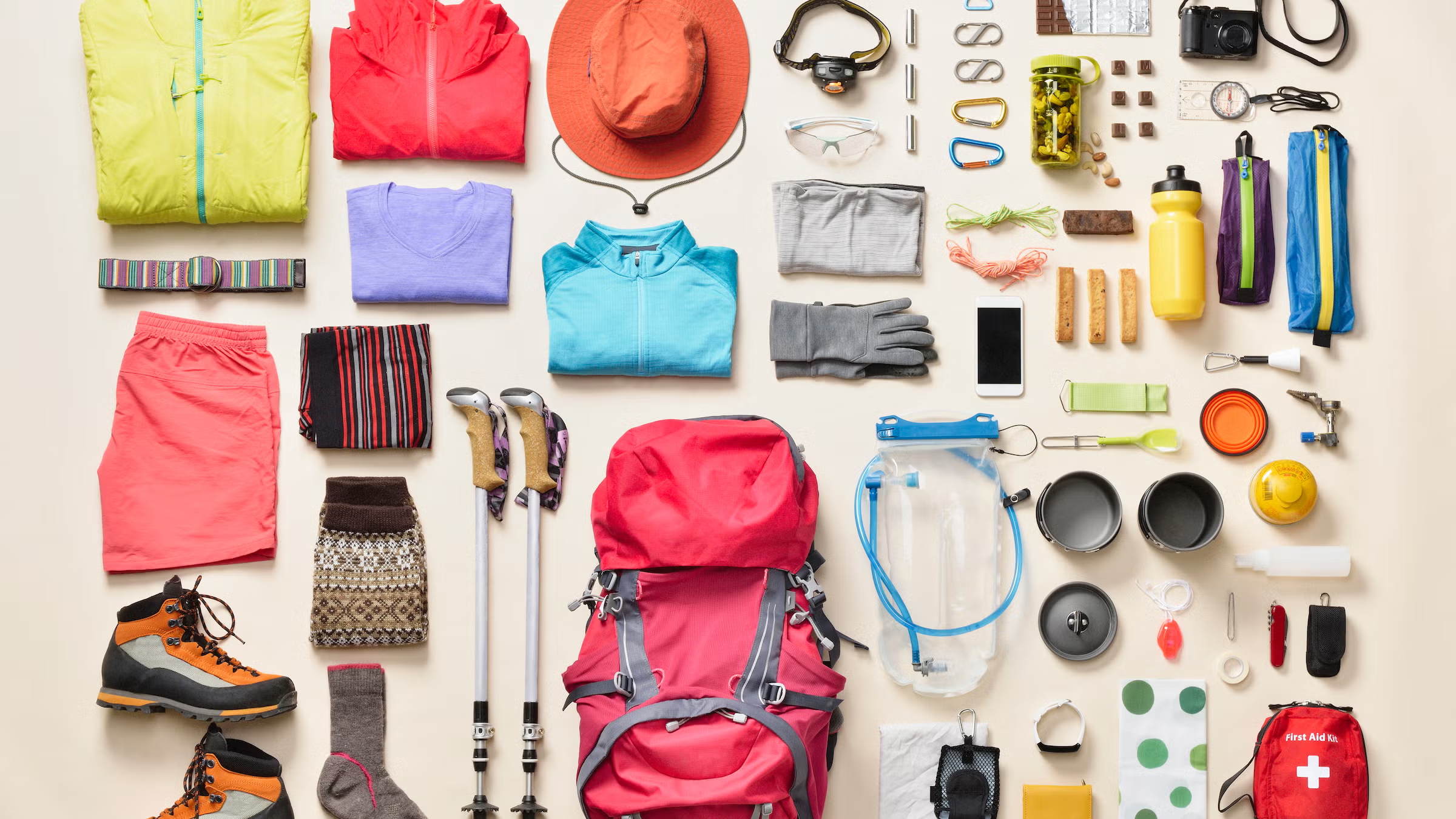
There are genuine safety items that belong on every trip regardless of weight: a navigation backup (offline map app plus compass), a reliable light source (headlamp with extra batteries), emergency shelter (a 2-ounce space blanket), fire starting capability, and a first aid kit scaled to your trip length. These don't get cut. Everything else is negotiable. Distinguish between items that prevent emergencies and items that prevent inconveniences. Prevent emergencies. Accept inconveniences.
9. Carry Less Water by Knowing Your Sources
Water is heavy — roughly 2.2 pounds per liter. Experienced hikers are meticulous about knowing exactly where water sources are on their route so they carry the minimum between them rather than the maximum at all times.
Before any trip, map your water sources using topographic maps, recent trip reports, and tools like FarOut (formerly Guthook) for popular trails. On a trail with reliable water every 3-5 miles, there's no reason to start a day with 3 liters — 1.5-2 is typically sufficient.
A lightweight squeeze filter like the Sawyer Squeeze weighs about 3 ounces and allows you to top up at any clean source rather than front-loading water. That's a vastly lighter system than carrying 4+ liters as insurance against uncertainty.
10. Build Skills, Not Just a Gear List
Ultralight backpacking is ultimately a skill set, not just a gear choice. The lightest piece of gear you can carry is knowledge — and experienced hikers leverage skills to replace weight in ways beginners can't.
Navigation skills mean you can travel more efficiently and carry less redundant gear. Campsite selection skills mean you can use a lighter shelter because you know how to find naturally protected sites. Layering knowledge means you can pack a smaller clothing kit because you understand exactly how to use what you bring.
The ultralight progression: every trip teaches you what you actually used. Every trip, your kit gets slightly lighter. After a few seasons, you'll be carrying half what you started with and hiking twice as far. The goal isn't the lightest pack on the trail — it's the lightest pack you can carry safely and comfortably for the trip you're actually taking.
The Bottom Line
Cutting pack weight isn't about deprivation — it's about precision. Every pound you remove is a pound your knees, hips, and shoulders don't carry for every mile of every trip. Over a long day or a multi-day route, that compounds into real physical benefit: less pain, more miles, more enjoyment.
Start with the Big Three. Weigh everything. Choose multi-purpose gear. Be honest about what you actually use. The ounces take care of themselves.
Explore Trailwise Gear's hiking backpacks collection for lightweight pack options, and browse the full gear selection for trail-tested ultralight equipment at every price point.
Products We Recommend
Written by
Sarah Chen
Gear Analyst & Writer · Trailwise Gear
Sports science graduate with a background in biomechanics. Brings data-driven analysis to gear testing — quantifying comfort, weight distribution, and material performance.
Ultramarathon Runner · Alpine Mountaineer
Meet the full team →
Find the Best Gear
Browse our expert-ranked gear categories.