Do You Actually Need Trekking Poles?
Poles aren't just for older hikers — research shows they reduce knee stress by up to 25% and improve stability on any terrain. Here's how to decide and what to buy.
Key Takeaways
- What Trekking Poles Actually Do — The Research: The benefits of trekking poles aren't just anecdotal.
- Who Benefits Most From Trekking Poles: Hikers with knee pain, osteoarthritis, or any joint issue in the knees, hips, or ankles benefit most.
- Who Might Not Need Them: Trekking poles aren't universally necessary.
- Choosing the Right Poles: Aluminum poles are durable, affordable, and bend rather than snap under stress — the practical choice for most beginners.
Poles aren't just for older hikers or people with bad knees — research shows they reduce knee stress by up to 25% and improve stability on any terrain. But they're also not essential for every hiker on every trail.
The honest answer: it depends on what you're hiking, how far, and what your body tells you. For many hikers — especially on anything with significant elevation change or technical terrain — trekking poles transform the experience. For others, on shorter, flatter hikes, they're extra weight and extra fuss.
This guide cuts through the debate with the actual evidence behind poles, who benefits most, how to use them correctly (most people don't), and how to decide whether they belong in your kit.
What Trekking Poles Actually Do — The Research
The benefits of trekking poles aren't just anecdotal. They've been studied in biomechanics labs and in the field, and the findings are consistent and meaningful.
The most well-documented benefit is reduced compressive force on the knees during downhill walking. Going downhill puts compressive forces on the knees that are three to four times higher than level walking — and that's before adding pack weight. Multiple studies have measured significant reductions in knee joint loading when trekking poles are used correctly. Reductions in knee stress in the range of 20-25% have been observed across different pack weights and terrains. For a hiker descending 3,000 feet over 5 miles, that's a meaningful cumulative difference.
Poles create additional points of contact with the ground, converting a two-point stance into a four-point one. This significantly lowers your effective center of gravity and improves balance on uneven, slippery, or technical terrain. Research has confirmed that poles reduce the risk of ankle rolls and falls — particularly valuable on wet rock, loose scree, and creek crossings.
On ascents, poles help engage your upper body in the climbing effort — distributing work from your legs and glutes to your arms and core. Studies suggest poles can reduce perceived exertion by meaningful amounts on steep inclines, meaning you feel less tired even when covering the same ground at the same pace.
Studies have also measured lower levels of markers for muscle and cartilage damage in the days following hikes when poles were used, suggesting that the load redistribution they provide has recovery benefits beyond the hike itself.
- Reduce knee stress by 20-25% on descents
- Improve balance and stability on uneven terrain
- Reduce perceived exertion on steep ascents
- Lower muscle and cartilage damage markers post-hike
Who Benefits Most From Trekking Poles
Hikers with knee pain, osteoarthritis, or any joint issue in the knees, hips, or ankles benefit most. The load redistribution poles provide reliably reduces joint stress in ways that let many hikers with chronic pain continue hiking distances they otherwise couldn't manage. For many hikers in this category, poles are the difference between hiking and not hiking.
Pack weight shifts your center of gravity upward and backward, destabilizes your balance, and dramatically increases the forces on your knees during descents. Poles counteract all three effects. If you're doing any serious backpacking — carrying a loaded hiking backpack over multiple days — poles are worth strong consideration regardless of your knee health.
Stream crossings, loose rock, exposed ridgelines, muddy trail sections, and steep switchbacks all benefit from the added stability that poles provide. In these conditions, poles aren't just comfortable — they're safety gear.
Beginner hikers also benefit significantly. Beginners often don't have the conditioned trail legs that experienced hikers develop over time. Poles provide protection during that adaptation period and help beginners maintain better posture and rhythm on the trail.
Who Might Not Need Them
Trekking poles aren't universally necessary. On a level trail with good footing — a flat rail trail, a well-groomed nature walk — poles don't provide meaningful benefit and require you to manage two extra pieces of equipment. Most experienced hikers stow their poles on flat sections and deploy them for climbs and descents.
On sections that require using your hands — climbing over boulders, navigating very steep terrain that demands balance with your arms — poles actively get in the way. Most poles can be collapsed and stowed on your pack for these sections.
Some hikers simply don't like the rhythm of hiking with poles, find them distracting, or prefer to keep their hands free. This is a legitimate preference, particularly on easier terrain. If you hike mostly on gentle to moderate trails without significant elevation and your knees feel good afterward, you may not benefit enough to justify the addition.
Choosing the Right Poles
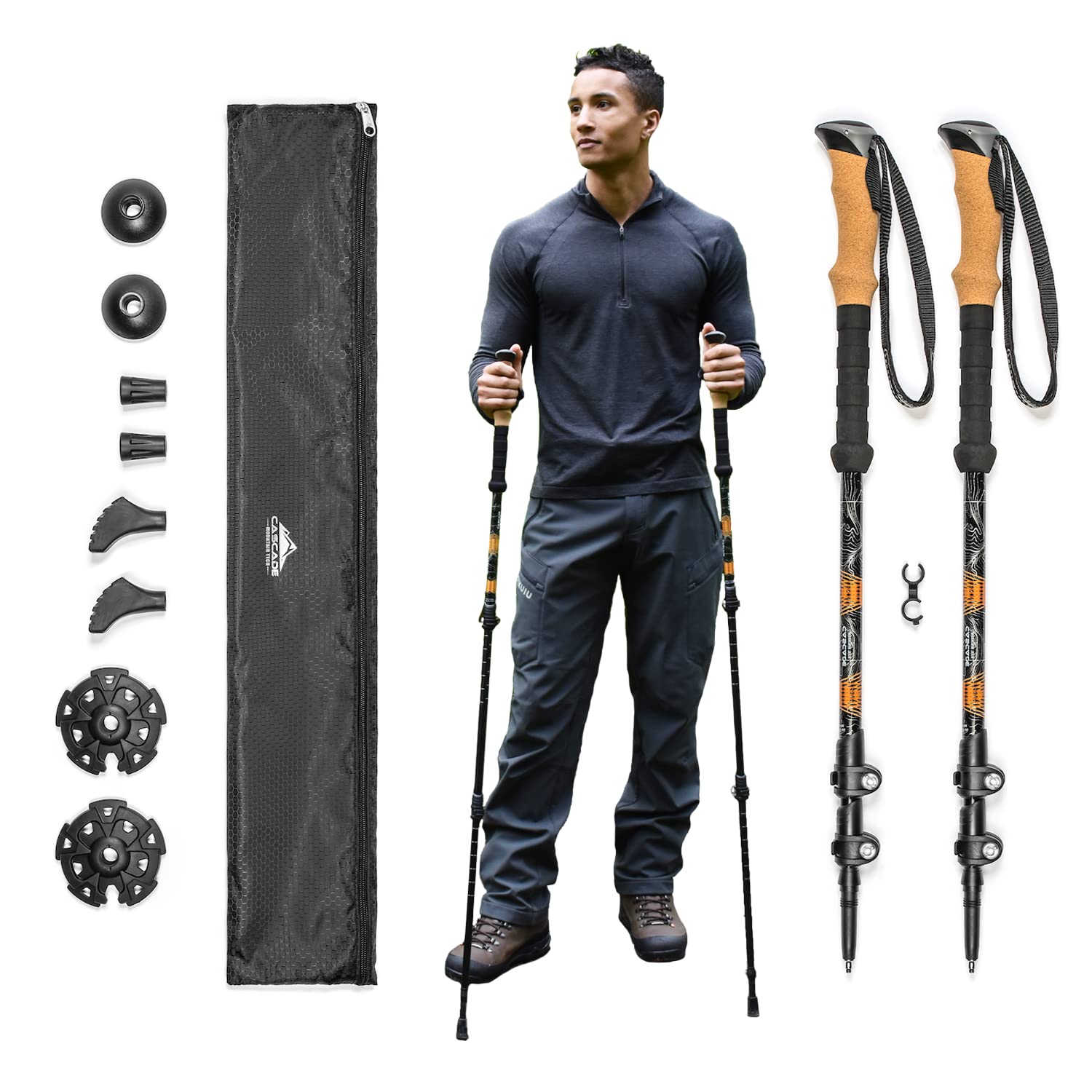
Aluminum poles are durable, affordable, and bend rather than snap under stress — the practical choice for most beginners. A quality aluminum pole pair runs $40-100. Carbon fiber poles are lighter and transmit less vibration to your hands, but more expensive ($100-300+) and can snap without warning under sudden lateral force. For most recreational hikers, aluminum is the better starting point.
Lever-lock (flip-lock) systems use external clamps to secure the pole at a set length. They're fast to adjust on the fly and easy to use with gloves — most modern poles use this system. Twist-lock systems are reliable but slower and can be harder to operate in cold conditions.
Collapsible poles (two or three sections) pack down small and can be stowed on your pack when not needed. They're the standard for hiking. Fixed-length poles are lighter but impractical for the varied terrain where adjustability matters most.
For poles labeled as trekking poles specifically, look for carbide or steel tips for rock grip, anti-shock mechanisms, and terrain-specific baskets (small for hard surfaces, larger for snow).
How to Use Them Correctly
Most people who try trekking poles and don't like them are using them incorrectly — usually with the wrong height or without using the straps properly.
The starting height for flat terrain: stand upright with the pole tip on the ground beside your foot. Your elbow should bend at approximately 90 degrees when holding the grip. Shorten by 5-10 centimeters on steep uphills. Lengthen by 5-10 centimeters on steep descents. On sidehills, shorten the uphill pole and lengthen the downhill pole.
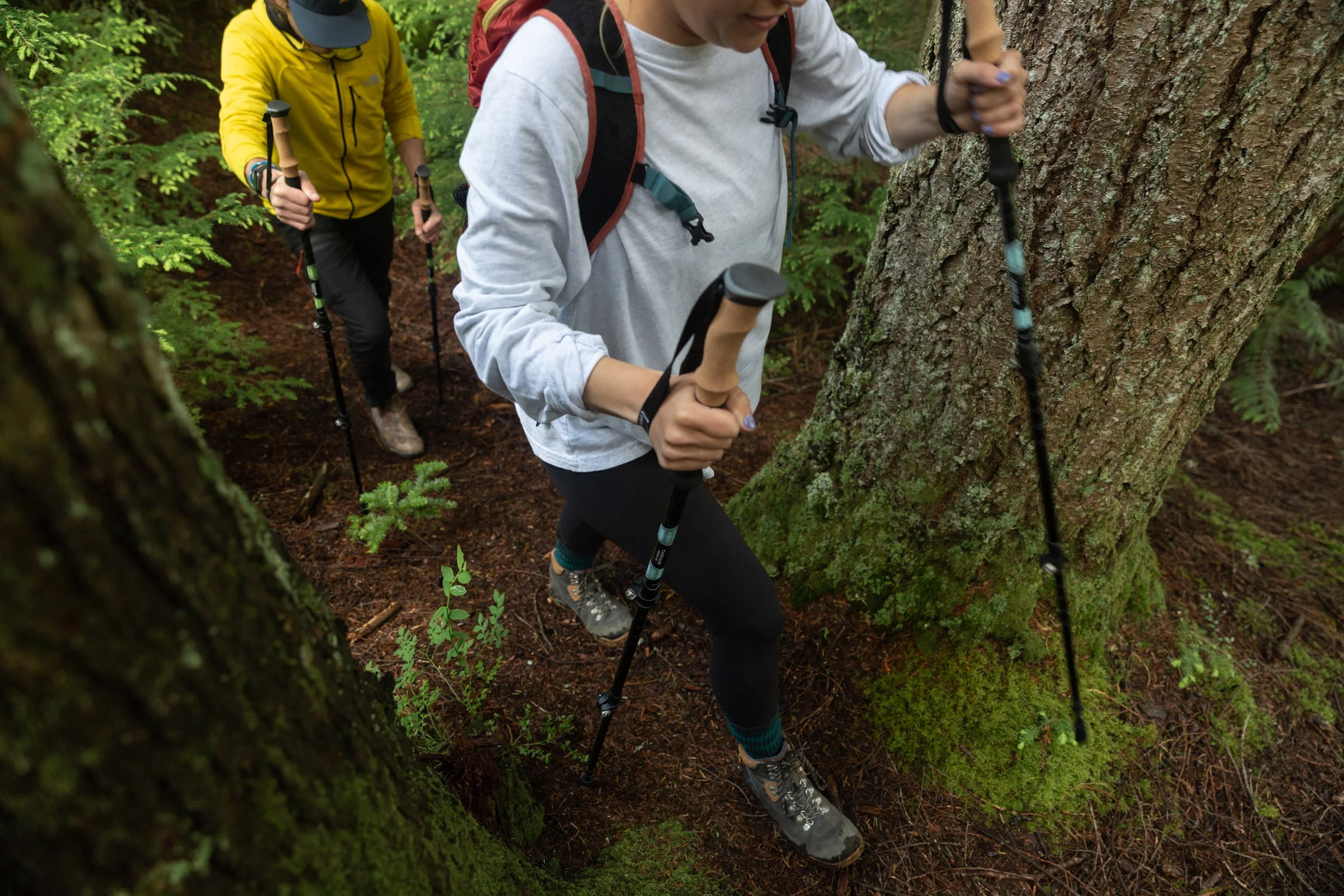
For straps: thread your hand up through the bottom of the strap (not over the top), then grip the pole so the strap runs across your palm between thumb and forefinger. When adjusted correctly, the strap cradles your hand and allows you to push down on the strap during the pole plant rather than gripping the handle tightly. This reduces hand fatigue dramatically on long hikes.
The most natural technique is the alternating or opposite motion: left pole plants forward as your right foot steps forward, and vice versa. This mirrors the natural arm swing of walking. On very steep terrain or descents, you can double-plant (both poles simultaneously) for maximum stability on each step down. Two poles provide meaningfully better results than one — the bilateral support is what creates the stability benefit.
- Baseline height: elbow at 90 degrees with tip on ground
- Shorten 5-10cm for uphills, lengthen 5-10cm for descents
- Thread strap from below — push on strap, don't grip tightly
- Alternate motion: left pole with right foot
- Use two poles, not one — bilateral support is the key benefit
The Bottom Line
Trekking poles aren't just for people who need them — they benefit most active hikers, particularly on anything with meaningful elevation. The research on knee stress reduction is real, the balance improvements are real, and the recovery benefits are real.
Try a pair on your next hike with elevation change and pay attention to how your knees feel the following day. Most hikers who make this comparison become pole converts fairly quickly.
You don't need to spend a fortune to start. A solid aluminum adjustable pair in the $40-80 range will tell you everything you need to know about whether poles belong in your regular kit.
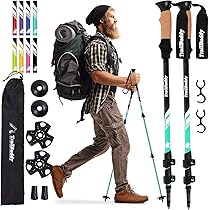
Explore Trailwise Gear's trekking pole recommendations for trail-tested options at every price point — and pair them with the right hiking boots to complete your trail setup.
Products We Recommend
Written by
Sarah Chen
Gear Analyst & Writer · Trailwise Gear
Sports science graduate with a background in biomechanics. Brings data-driven analysis to gear testing — quantifying comfort, weight distribution, and material performance.
Ultramarathon Runner · Alpine Mountaineer
Meet the full team →
Find the Best Gear
Browse our expert-ranked gear categories.